Market Cycle Stage- November 2025
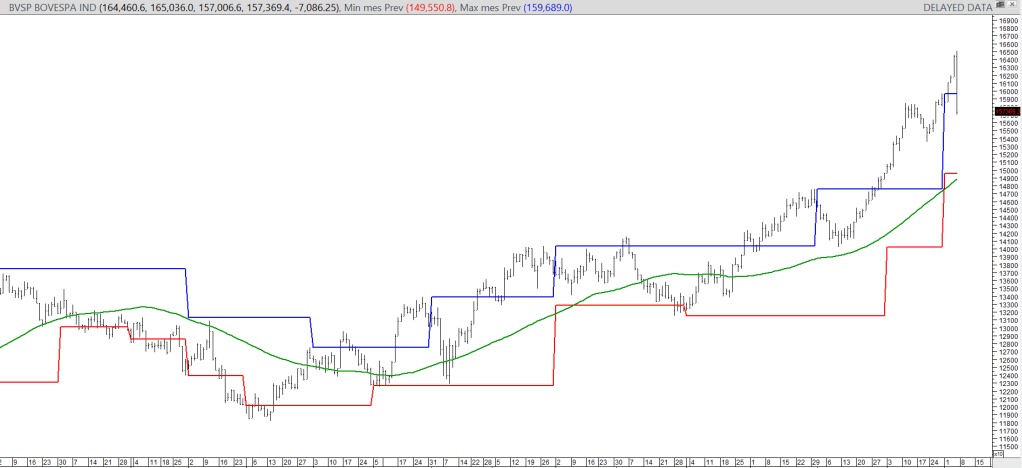
The index has recently broken out above the 159,000 level after a strong, persistent uptrend. Price has surged sharply and almost vertically from ~145,000 in late September to ~165,000, with minimal pullbacks.
This kind of sharp upward acceleration following a breakout from a consolidation range is typical of Stage 11: Euphoria, where confidence turns into exuberance.
Technical Analysis Summary
Support Levels:
148,000–150,000: Prior breakout zone and current location of 50-day MA.
143,000: Red step level (structural support before breakout).
Resistance Levels:
None in the chart — the index is in price discovery.
Psychological zones to watch: 170,000, 175,000, etc.
MACD (Inferred)
Although not visible, based on price action:
- MACD is likely very positive, showing strong momentum.
- No signs of divergence or topping yet.
Momentum confirms trend but may become overbought if price continues vertically.
Macro & Event Overview
Monetary Policy & Inflation
The Central Bank of Brazil (Copom) raised the benchmark Selic interest rate to 15% in June 2025 and has held it there through Q3. The bank signaled that inflation is converging slower than expected and that rate cuts are unlikely before 2026.
Inflation Trends. Year-end IPCA inflation is projected at ~5.1–5.3%, well above the 3% target (±1.5 pp). The Central Bank sees inflation falling to ~3.2% by end-2027.
Monetary Policy Outlook. Central Bank governor Roberto Campos Neto stated that “interest rates will need to stay high for longer than expected,” and markets have priced out cuts until early–mid 2026.
GDP & Economic Activity
Growth Forecasts. The Finance Ministry revised 2025 GDP growth upward to 2.5%, citing strong services activity and agricultural output. The IMF projects 2.3% growth in 2025 and 2.5% in 2026, supported by domestic demand and infrastructure investment.
Fiscal Framework and Challenges
Brazil is operating under a new fiscal rule (approved in 2023), which limits spending growth to 70% of revenue increases.
However, the government relaxed spending targets in mid-2025, citing higher-than-expected revenues and social spending needs.
Brazil’s exports especiallysoybeans, iron ore, and crude oil continue to support the trade balance. However, softening demand from China and lower global commodity prices in Q3 2025 pose a risk.
Brazil is expanding its trade with India, Southeast Asia, and the Middle East to reduce dependency on China.
Currency & External Accounts
The Brazilian real depreciated ~4% YTD, affected by global rate differentials and domestic fiscal noise.
U.S. Trade Tensions. The U.S. extended its decision on proposed 50% tariffs on Brazilian steel and aluminum until October 2025.
Market Cycle Stage- October 2025
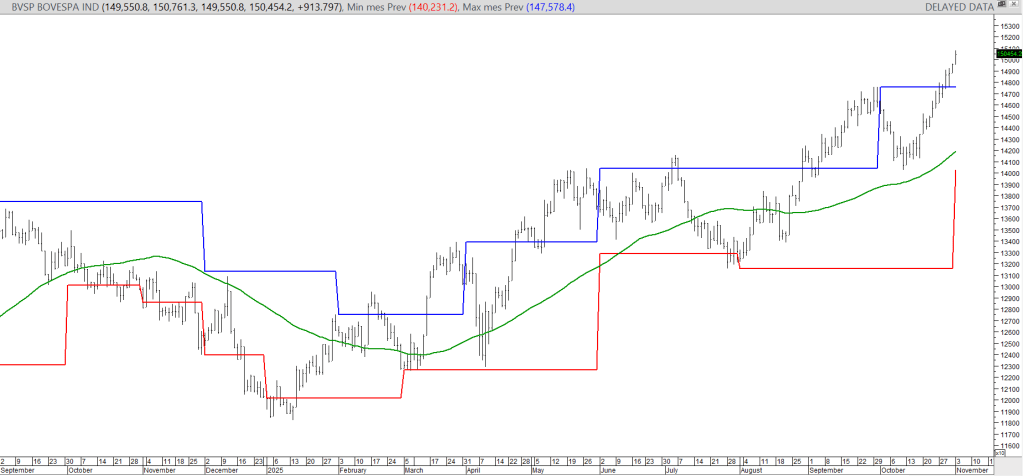
The Bovespa has surged to new highs above 150,000, clearing all prior resistance levels without major pullbacks. The move comes after a healthy consolidation between June and August, followed by a strong breakout and acceleration of the uptrend in October. The 50-day moving average (green line) is rising and trailing significantly below price, confirming strong bullish momentum.
Investors are likely gaining confidence and starting to chase the move, which suggests sentiment is entering the euphoria zone. Thrill: “I’m making money! This is exciting.” Euphoria: “The market is unstoppable.”
Technical Analysis Summary
Macro & Event Overview
Monetary Policy & Inflation
The Central Bank of Brazil (Copom) raised the benchmark Selic interest rate to 15% in June 2025 and has held it there through Q3. The bank signaled that inflation is converging slower than expected and that rate cuts are unlikely before 2026.
Inflation Trends. Year-end IPCA inflation is projected at ~5.1–5.3%, well above the 3% target (±1.5 pp). The Central Bank sees inflation falling to ~3.2% by end-2027.
Monetary Policy Outlook. Central Bank governor Roberto Campos Neto stated that “interest rates will need to stay high for longer than expected,” and markets have priced out cuts until early–mid 2026.
GDP & Economic Activity
Growth Forecasts. The Finance Ministry revised 2025 GDP growth upward to 2.5%, citing strong services activity and agricultural output. The IMF projects 2.3% growth in 2025 and 2.5% in 2026, supported by domestic demand and infrastructure investment.
Fiscal Framework and Challenges
Brazil is operating under a new fiscal rule (approved in 2023), which limits spending growth to 70% of revenue increases.
However, the government relaxed spending targets in mid-2025, citing higher-than-expected revenues and social spending needs.
Brazil’s exports especially soybeans, iron ore, and crude oil continue to support the trade balance. However, softening demand from China and lower global commodity prices in Q3 2025 pose a risk.
Brazil is expanding its trade with India, Southeast Asia, and the Middle East to reduce dependency on China.
Currency & External Accounts
The Brazilian real depreciated ~4% YTD, affected by global rate differentials and domestic fiscal noise.
U.S. Trade Tensions. The U.S. extended its decision on proposed 50% tariffs on Brazilian steel and aluminum until October 2025.
Market Cycle Stage- August 2025
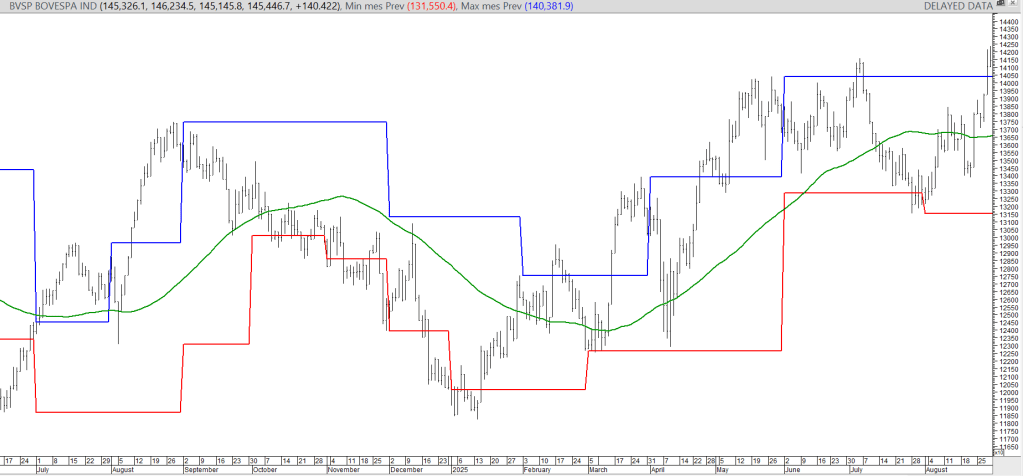
The index has just broken out to a new high above previous resistance from May and July .The prior consolidation from June to late July is now resolved to the upside. The red support line has shifted upward, showing that the market is building higher bases. Momentum and sentiment are accelerating ,common in the Thrill phase, when the trend is undeniable and participation increases. “This market is delivering gains”, time to add more.” Bullish sentiment becomes widespread.
Technical Analysis Summary
Support Levels:
132,500 – previous red step base.
137,000–138,000 – prior breakout area.
Resistance Levels:
Recently broken: 142,000
MACD (Momentum Indicator)
Previously, MACD was turning up .Price behavior and moving average positioning imply positive momentum remains intact.
Momentum confirms bullish breakout.
Key Insight: Momentum is aligned with the breakout; likely in acceleration mode unless divergence appears.
Macro & Event Overview
Monetary Policy & Inflation
Inflation Trends
Headline inflation (IPCA) is projected to close 2025 at ~5.1%, above the 3% target band (±1.5 pp).
Inflationary pressures are easing but remain sticky due to services and regulated prices (e.g. electricity, fuel).
Inflation is not expected to reach target until late 2027, per Central Bank forecasts.
Monetary Policy Outlook
Markets do not expect any interest rate cuts before 2026.
GDP & Growth Forecasts
Government Forecast
The Finance Ministry revised 2025 GDP growth up to 2.5%, due to strong Q2 activity in services and agriculture.
Moderate slowdown expected in H2 2025 due to tight credit conditions and external headwinds.
Private & International Projections
IMF and Reuters consensus sees GDP at ~2.2% in 2025 and 1.7% in 2026.
Fiscal Policy & Debt
Primary Fiscal Deficit
Expected deficit for 2025: ~R$104 billion, with gross public debt reaching 76% of GDP.
External Sector & Trade Risks
U.S. Tariffs Risk
The U.S. extended negotiations over a proposed 50% tariff on Brazilian aluminum and steel exports to October 2025.
Commodity Prices
Brazil’s economy remains heavily influenced by soybeans, iron ore, and crude oil prices.
Falling Chinese demand and volatile global prices could pressure exports in Q4 2025.
Currency & Foreign Exchange
Brazilian Real Performance
The real has depreciated ~4% YTD against the U.S. dollar due to global risk
FX volatility may continue if fiscal signals remain weak or U.S. trade actions escalate.
FX Reserves
Brazil continues to hold over $340 billion in international reserves, offering resilience against external shocks.
Market Cycle Stage- July 2025
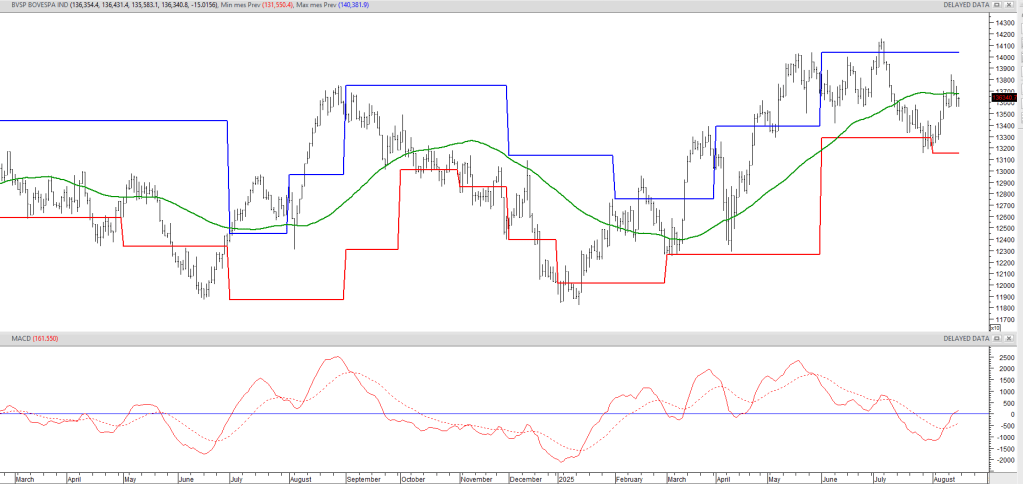
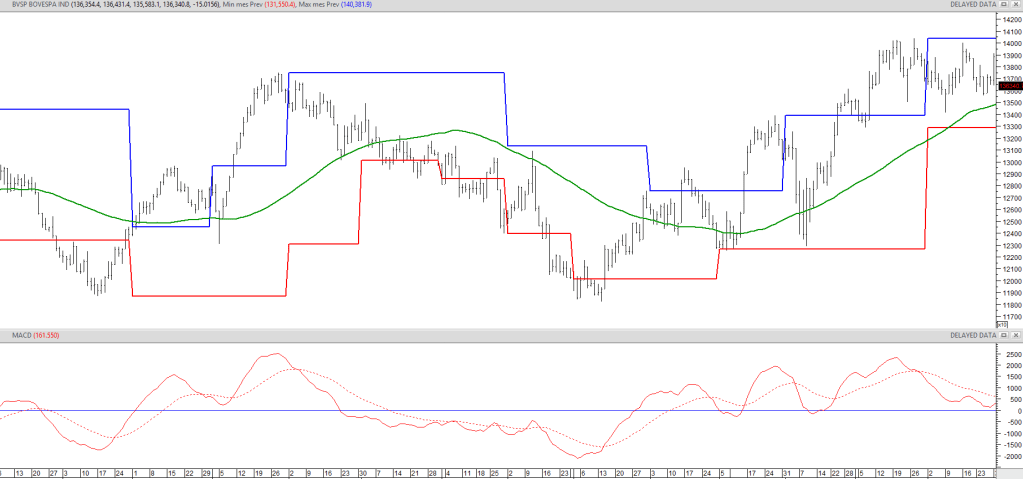
The market rebounded off the 12,300 lows and is now testing the 50-day moving average. Traders remain cautious, unsure if this is a true recovery or another fakeout, even as the MACD has turned positive and price consolidates near the moving average. This reflects the transition from Stage 5 Disbelief, where sentiment doubts a rebound, toward Stage 6 “Hope”, where investors begin to consider the possibility of a real recovery.
Technical Analysis Summary
Support & Resistance
- Support Levels:
- ~13,200 – recent pivot low and key structural level.
- ~12,300 – strong base formed in June.
- Resistance Levels:
- ~13,800 – blue step resistance.
- ~14,000+ – psychological and technical ceiling from prior highs.
Key Insight: Consolidation between 13,200–13,800; breakout would trigger entry into Hope/Optimism.
MACD (Momentum Indicator)
- Recently turned positive after a multi-week downtrend.
- MACD crossed the signal line a bullish crossover.
- Momentum is rising, though not yet strong.
Key Insight: Early stage momentum indicator showing potential for a new bullish leg.
Macro & Event Overview
Monetary Policy & Inflation
- Selic Interest Rate:
In June 2025, the Central Bank of Brazil (Copom) raised the Selic rate to 15%, its highest level since 2006. This was in response to persistent inflationary pressures. - Inflation Outlook:
- The 2025 inflation forecast has been adjusted to ~5.1%, still above the central bank’s target of 3% ±1.5pp.
- Inflation is projected to gradually decline toward the target range by end-2027.
- Policy Outlook:
- The Central Bank has signaled a pause in rate hikes to assess their impact.
- However, rate cuts are not expected until 2026, according to major banks like Itaú.
🔹 GDP Growth Forecasts
- Finance Ministry Outlook:
- 2025 GDP growth revised upward to 2.5% from 2.4%.
- The government anticipates a moderation in growth in 2026 due to global uncertainty and tight monetary policy.
- Private Sector & IMF:
- Private economists and the IMF forecast ~2.2% growth in 2025 and a slower pace in 2026.
🔹 Fiscal Policy & Public Finances
- Deficit & Debt:
- Brazil is running a primary deficit near R$104 billion, with public debt approaching 76% of GDP.
- Fiscal pressures have raised concerns over debt sustainability.
- New Fiscal Framework:
- A new spending cap framework is being monitored.
- The market is watching whether President Lula’s administration will respect spending ceilings.
🔹 U.S. Tariffs and Trade Risks
- Upcoming Tariff Risk (August 1, 2025):
- The U.S. has proposed 50% tariffs on select Brazilian exports, citing trade imbalances and industrial policy concerns.
- If implemented, this could hurt GDP, raise inflation, and pressure the Brazilian real.
- Export Sensitivity:
- Brazil’s dependence on agricultural and mineral exports makes it vulnerable to such trade actions.
🔹 Currency & External Balance
Brazil maintains healthy reserves, helping contain external shocks.
Brazilian Real:
The real has shown some weakness in response to rate expectations and trade tension.
Currency depreciation adds inflationary pressure but supports exports.
FX Reserves:
Brazil maintains healthy reserves, helping contain external shocks.
Market Cycle Stage- June 2025
Based on the latest chart data, the BOVESPA index appears to be in the ‘Hope’ phase of the market cycle. This stage is characterized by an initial rebound following a downtrend, with cautious optimism among investors. The rebound is not yet fully confirmed by technical
indicators.
Technical Analysis comments
Trend & Price Action
- Support Levels:
- 114,000: A horizontal support level with multiple recent bounces.
- 107,000: A deeper support from earlier in 2023 and late 2022.
- Resistance Levels:
- 122,500: Minor resistance from a local peak.
- 126,000 – 127,500: Key resistance zone before the major drop.
- Trend Direction:
- Medium-term trend remains downward, though recent candles suggest potential
stabilization. - Long-term trend is at risk of turning bearish if the index breaks below 114,000.
Moving Averages - 50-day MA: Sloping downward, above the current price — bearish pressure.
- 200-day MA: Still upward but flattening, indicating weakening long-term momentum.
MACD - Histogram: Turning positive, showing early bullish divergence.
- Signal line crossover: Close to or just above zero, suggesting incipient bullish momentum.
RSI (Relative Strength Index) - RSI is around 45–50, indicating a neutral state — neither overbought nor oversold.
Macro & Event Overview
Central Bank Policy
- SELIC rate decisions are key. A potential rate cut is speculated amid easing inflation.
- Market volatility expected ahead of the July monetary policy meeting.
Inflation and Fiscal Discipline
- Brazil has reported moderating inflation, but fiscal risks persist.
- Debates on public spending caps and pension reforms could influence market sentiment.
Global Commodities
- BOVESPA is sensitive to iron ore, soybeans, and oil prices.
- Weakness in China’s demand may pressure commodity-linked equities.
Political Landscape
- President Lula’s administration pushes pro-labor and environmental policies.
- Concerns over market-unfriendly reforms have added volatility.
Currency Volatility
- The Brazilian real shows signs of weakening. A depreciation could help exports but hurt
foreign investment sentiment.
International Risk Appetite
Emerging market ETFs and sovereign bond risk premiums are key watchpoints.
Global equity sentiment and U.S. interest rates will impact foreign flows.
 Market Mindset LATAM
Leave a comment